|
May Day, May Day, May Day!
|
|
|
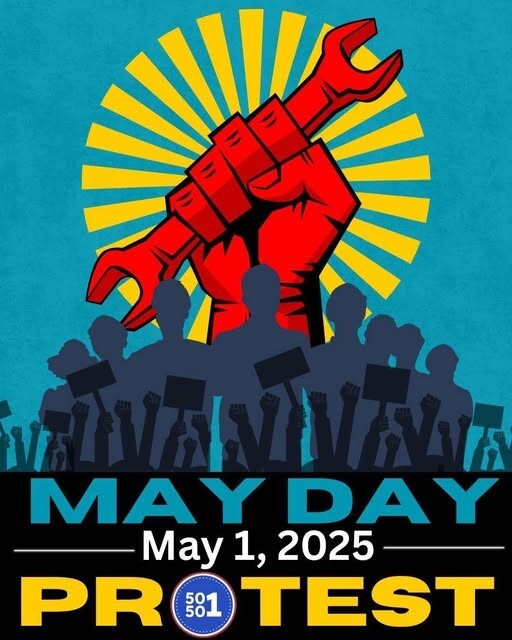 May 1, 2025 | COMMENTARY | The term “Mayday” comes from the French phrase “m’aidez” or “venez m’aider”—meaning “help me” or “come help me.” It is a loanword adopted into English to serve as an international distress call. The term was coined in the 1920s by Frederick Stanley Mockford, a senior radio officer at Croydon Airport near London, who needed a word easily understood by both English and French-speaking aviators and mariners. “Mayday” was officially adopted as the standard spoken distress signal at the International Radiotelegraph Convention in Washington, D.C., in 1927. The signal must be spoken three times in succession to ensure clarity and avoid confusion with similar-sounding words. Visually, the equivalent would be flying the American flag upside down—a recognized symbol of dire distress. But May 1st carries far more than an emergency signal. Daily Kos May 1, 2025 | COMMENTARY | The term “Mayday” comes from the French phrase “m’aidez” or “venez m’aider”—meaning “help me” or “come help me.” It is a loanword adopted into English to serve as an international distress call. The term was coined in the 1920s by Frederick Stanley Mockford, a senior radio officer at Croydon Airport near London, who needed a word easily understood by both English and French-speaking aviators and mariners. “Mayday” was officially adopted as the standard spoken distress signal at the International Radiotelegraph Convention in Washington, D.C., in 1927. The signal must be spoken three times in succession to ensure clarity and avoid confusion with similar-sounding words. Visually, the equivalent would be flying the American flag upside down—a recognized symbol of dire distress. But May 1st carries far more than an emergency signal. Daily Kos
|
|
|
|